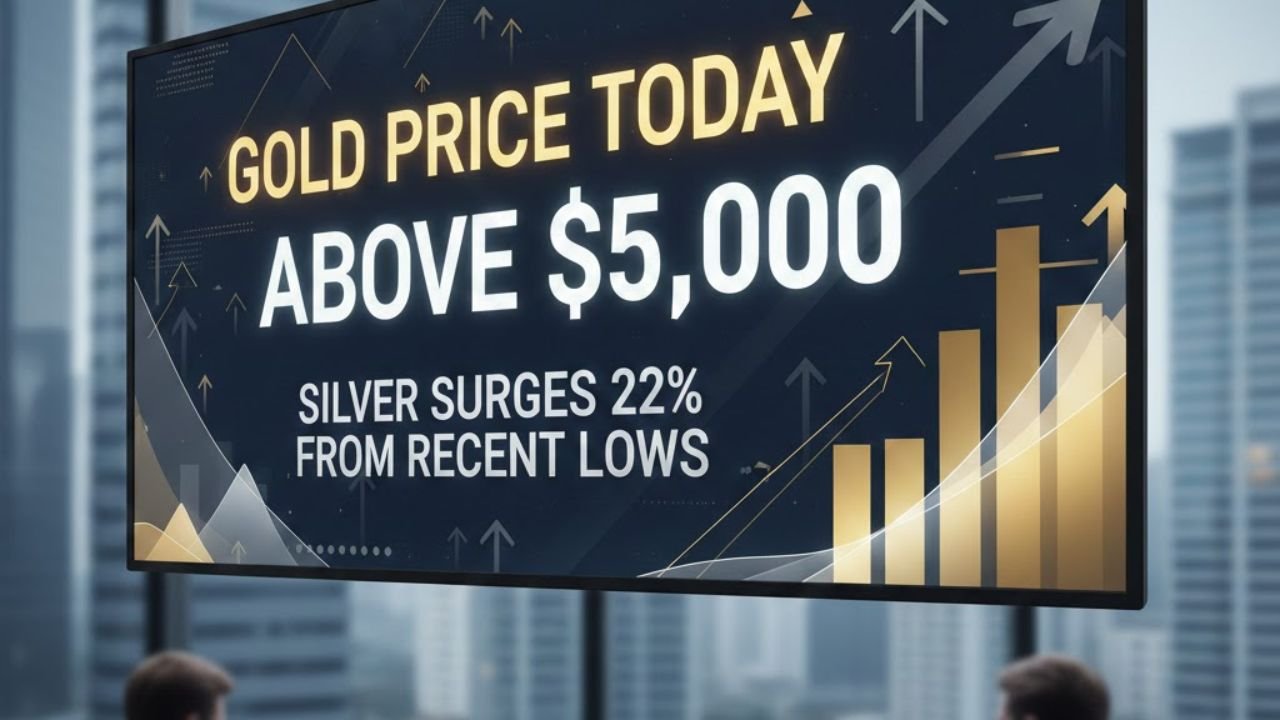
the global financial landscape has been reshaped by a historic surge in precious metals. For the first time in history, gold has decisively breached the $5,000 per ounce threshold, while silver has staged a ferocious 22% recovery from its recent lows. This dual rally marks a significant turning point for investors, signaling a deep-seated shift in how the market perceives risk, currency stability, and industrial scarcity. As traditional fiat currencies face headwinds from persistent inflation and geopolitical rebalancing, bullion has reclaimed its throne as the ultimate store of value.
Gold’s Historic Ascent Beyond the $5,000 Milestone
The psychological and technical barrier of $5,000 was once considered a “long-term target,” but as of February 2026, it is the new reality. This rally has been fueled by a “perfect storm” of macroeconomic triggers. Central banks, particularly those in emerging markets, have accelerated their de-dollarization efforts, diversifying their reserves into physical gold at an unprecedented pace. Furthermore, the Federal Reserve’s struggle to maintain a balance between interest rates and national debt has caused investors to flee toward non-yielding assets that offer protection against currency debasement.
Silver’s Volatile Rebound and the 22% Surge
While gold has maintained a steady climb, silver has proven why it is often called “gold on steroids.” After a sharp correction earlier in the year that saw prices dip significantly, the white metal has surged 22% from its local bottom. This recovery is not just speculative; it is grounded in a widening supply-demand gap. Industrial demand for silver—driven by the explosion of AI hardware, data centers, and advanced photovoltaic technology—has outpaced mining production for the fifth consecutive year. This structural deficit has created a “floor” for prices, allowing silver to bounce back aggressively whenever market dips occur.
Comparative Market Data: Gold vs. Silver (February 2026)
| Asset Type | Current Price (Approx.) | Recent Low | % Recovery/Gain | Primary Driver |
| Gold (Spot) | $5,048 /oz | $4,660 /oz | +8.3% (Monthly) | Central Bank Buying |
| Silver (Spot) | $82 /oz | $67 /oz | +22.4% | Industrial Deficit |
| Gold (MCX) | ₹1,58,060 /10g | ₹1,43,500 /10g | +10.1% | Rupee Volatility |
| Silver (MCX) | ₹2,84,000 /kg | ₹2,32,000 /kg | +22.4% | Tech Manufacturing |
The Role of Central Banks and Geopolitical Tensions
The current price action is heavily influenced by the People’s Bank of China and other major institutions, which have continued their gold-buying spree for over 15 consecutive months. Geopolitical friction in the Middle East and shifting trade alliances have further solidified the “safe-haven” narrative. When tensions rise or trade tariffs are announced, the immediate market reaction is a pivot into gold and silver. Investors are no longer viewing these metals as mere hedges, but as core components of a resilient portfolio in an increasingly multipolar world.
Industrial Scarcity: The Secret Engine Behind Silver
Silver’s recent 22% jump is unique because it reflects its dual identity as both a monetary asset and a critical industrial material. In 2026, the transition to green energy and the massive expansion of the “AI-Economy” have placed a premium on silver’s conductivity. Unlike gold, silver is often “consumed” in industrial processes, meaning it is harder to recycle back into the market quickly. This “silver squeeze” is becoming a recurring theme, where any sign of a supply disruption leads to massive price spikes as manufacturers scramble to secure physical inventory.
Technical Outlook and Investor Sentiment
From a technical perspective, the breakout above $5,000 for gold has turned previous resistance into a formidable support level. Analysts suggest that as long as gold holds this psychological floor, the path toward $5,500 remains open. For silver, the focus is on the $90 to $100 range, which many experts believe is the next logical target if the gold-to-silver ratio continues to compress. Investor sentiment remains “bullish but cautious,” as the extreme volatility requires a disciplined approach to entry and exit points in the futures market.
Diversification Strategies in a High-Price Environment
With gold at record highs, many retail investors are turning to Silver ETFs and fractional gold ownership to maintain exposure. The 62% XIRR (internal rate of return) seen in silver investments over the last few years has outperformed many traditional equity indices. However, financial advisors warn against “chasing the peak.” The best strategy in this high-priced environment remains a systematic investment plan (SIP) or dollar-cost averaging, which allows participants to build positions without being overly exposed to the intraday swings that characterize today’s precious metals market.
FAQs
Q1. Why did gold finally cross the $5,000 mark?
The surge was driven by a combination of central bank diversification away from the US dollar, persistent global inflation, and a flight to safety amid heightened geopolitical risks and economic uncertainty in 2026.
Q2. Is silver a better investment than gold right now?
Silver offers higher volatility and potential for larger percentage gains, as seen in its recent 22% surge. However, it also carries higher risk compared to the relative stability of gold.
Q3. Will prices continue to rise throughout 2026?
While the outlook remains bullish due to supply deficits and safe-haven demand, market experts anticipate periodic corrections. Investors should watch Federal Reserve policy and industrial demand signals for future direction.
Disclaimer
The content is intended for informational purposes only. you can check the officially sources our aim is to provide accurate information to all users.