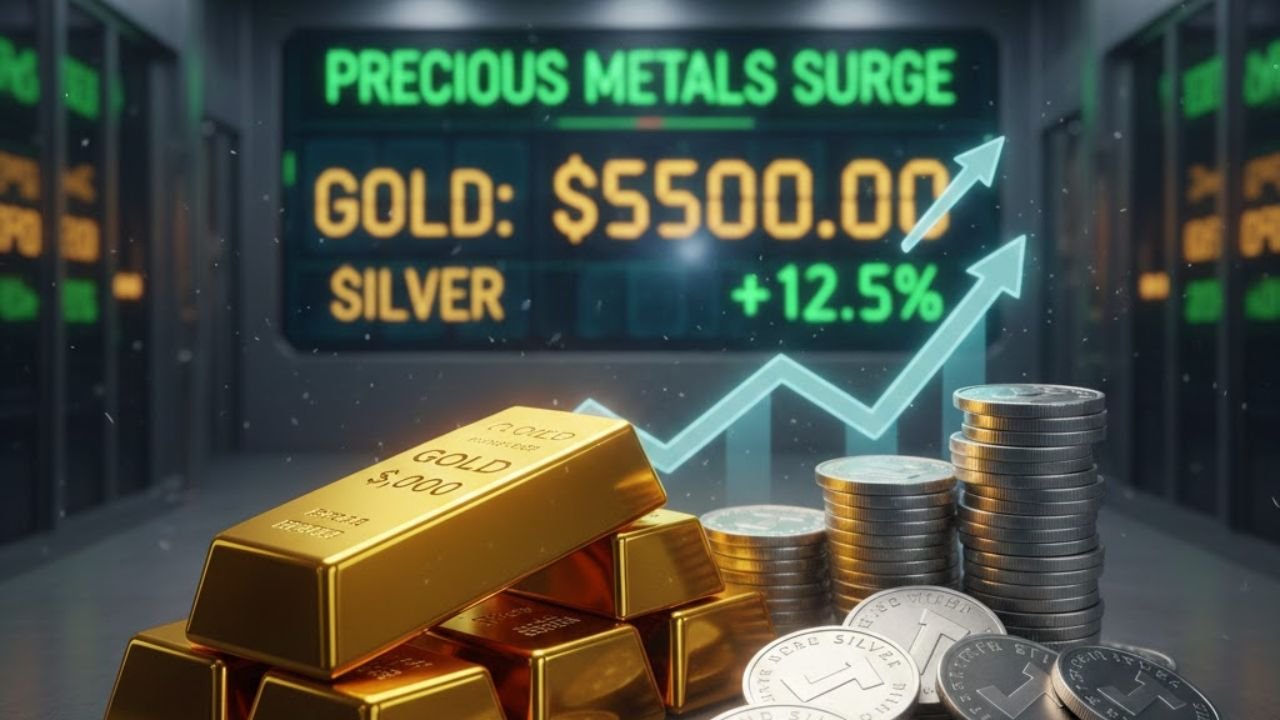
The financial landscape has reached a historic milestone in early 2026 as gold prices officially breached the psychologically critical $5,000 per ounce barrier. This monumental surge represents a significant shift in global market sentiment, driven by a “perfect storm” of geopolitical instability, currency debasement fears, and a structural pivot by central banks toward hard assets. While gold has commanded the headlines by reclaiming the $5,000 floor after a period of intense volatility, silver has staged an even more aggressive recovery, bouncing back toward the $90 mark. For investors, these movements are not merely technical fluctuations but signals of a deeper re-pricing of risk in an era defined by fiscal uncertainty and global trade tensions.
The Catalysts Behind the $5,000 Gold Milestone
The journey to $5,000 was fueled by a convergence of macro factors that made the yellow metal the ultimate sanctuary. Primary among these is the renewed friction in the Middle East and ongoing trade disputes involving the United States, which have sparked a “risk-off” environment. Furthermore, concerns regarding the independence of the Federal Reserve and the sustainability of mounting global debt have led many to question the long-term credibility of fiat currencies. This erosion of trust has funneled massive capital into gold ETFs and physical bullion, pushing the asset into a price-discovery phase where traditional valuation models are being rewritten by urgent demand.
Silver’s Aggressive Rebound and Industrial Demand
While gold acts as the steady anchor of the precious metals complex, silver has demonstrated its signature high-beta volatility. After a brutal sell-off that saw prices dip momentarily, silver has bounced back with a vengeance, outperforming gold in percentage terms. This recovery is underpinned by a chronic supply deficit—now in its sixth consecutive year. Unlike gold, silver’s value is heavily tied to the green energy transition. The exploding demand for silver in solar photovoltaic panels, electric vehicle (EV) components, and the hardware necessary for artificial intelligence (AI) data centers has created a floor for the metal that speculative selling can no longer suppress.
Central Bank Accumulation and De-dollarization
A pivotal driver of this rally is the aggressive and sustained accumulation of gold by central banks, particularly in emerging markets like China and India. These institutions are actively diversifying their reserves away from the U.S. dollar to mitigate the risk of sanctions and currency volatility. Reports indicate that central bank buying in 2026 remains at historic highs, with a structural shift toward “real assets” over paper-based securities. This institutional support provides a “hard floor” for gold prices, ensuring that even during periods of retail profit-taking, the broader uptrend remains intact.
Comparative Market Data: February 2026
| Precious Metal | Price Level (USD/oz) | Percentage Change (YTD) | Primary Driver |
| Gold | $5,070.28 | ~15% | Safe-haven demand / Central bank buying |
| Silver | $89.92 | ~22% | Industrial deficit / Green tech demand |
| Platinum | $1,245.00 | ~8% | Hydrogen economy / Automotive catalysts |
| Palladium | $1,110.00 | ~5% | Industrial recovery / Supply constraints |
The Role of Currency Devaluation and Inflation
Inflationary pressures, though fluctuating, have remained a persistent threat to purchasing power across major economies. In 2026, the “debasement trade” has become a central theme for wealth managers. As governments grapple with high interest-servicing costs and fiscal deficits, the allure of an asset that cannot be printed—like gold—becomes undeniable. This is especially evident in the Indian market, where domestic gold prices have hit record highs of over ₹1,57,000 per 10 grams, further amplified by a softening rupee against the dollar. For the average investor, gold has transitioned from a luxury to a necessary hedge against systemic financial instability.
Technical Outlook and Market Sentiment
From a technical perspective, the reclamation of the $5,000 level has transformed what was once a daunting resistance into a newfound support zone. Analysts suggest that as long as gold remains above this threshold, the path toward $6,000 is fundamentally open. For silver, the focus is now on the $100 psychological milestone, a target that many experts believe is achievable given the current industrial trajectory. However, the market remains sensitive to Federal Reserve policy; any unexpected hawkish shift or a sudden stabilization of geopolitical tensions could trigger short-term corrections.
Future Projections for Precious Metals
Looking ahead through the remainder of 2026, the outlook for precious metals remains decisively bullish. The unique convergence of investment demand and industrial necessity creates a dual-engine growth model for the sector. While volatility is expected to remain high—as seen with recent margin requirement changes in the futures markets—the long-term structural drivers are stronger than they have been in decades. Investors are increasingly viewing any price “dips” as strategic entry points rather than reasons for panic, signaling a robust and mature bull market that is likely to endure.
FAQs
Q1. Why did gold prices specifically target the $5,000 level in 2026?
The $5,000 mark was reached due to a combination of high geopolitical risk, central bank de-dollarization efforts, and a shift in investor sentiment toward real assets as a hedge against global debt and currency devaluation.
Q2. Is silver a better investment than gold at current prices?
Silver offers higher volatility and potential for larger percentage gains due to its dual role as an industrial metal and a store of value. Its current supply deficit makes it attractive, though it carries more risk than gold.
Q3. How do interest rates currently affect gold’s performance?
While higher interest rates typically make non-yielding assets like gold less attractive, the current market has seen a decoupling where gold prices rise alongside rates due to overwhelming safe-haven demand and fears of systemic financial stress.
Disclaimer:
The content provided in this article is for informational purposes only and does not constitute financial or investment advice. Always consult with a professional financial advisor and check official market sources before making investment decisions.